
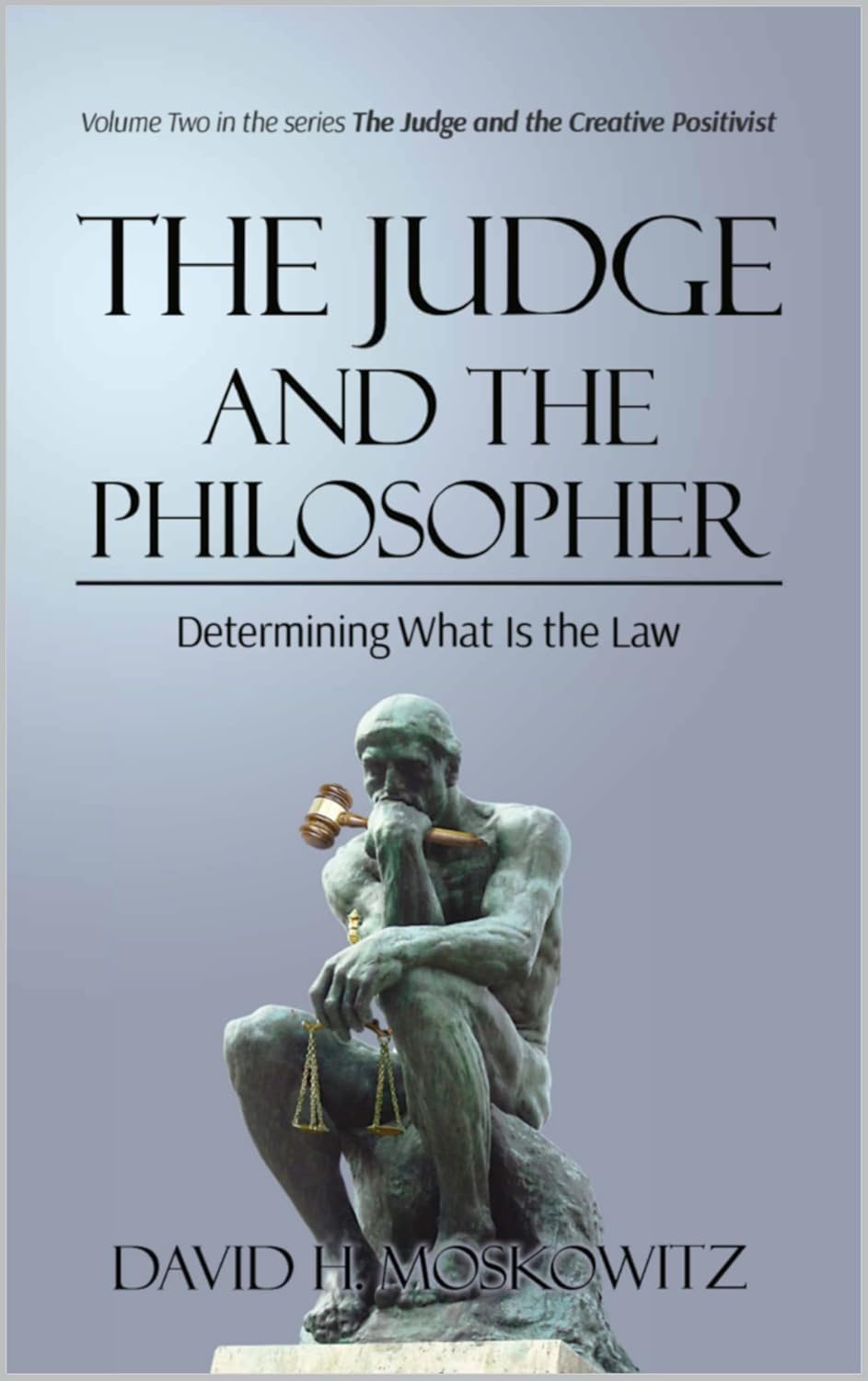
The Judge and the Philosopher: Determining What Is the Law: vol. 2 of an academic series for students and tutors evaluating and developing the concept of law (The Judge and the Creative Positivist)
Product details
| Management number | 237181462 | Release Date | 2026/07/10 | List Price | US$2.00 | Model Number | 237181462 | ||
|---|---|---|---|---|---|---|---|---|---|
| Category | |||||||||
This book is the second of four volumes published under the series title The Judge and the Creative Positivist. Creative positivism is a legal philosophy that is an extension of H.L.A. Hart’s legal positivist theory presented in his classic work The Concept of Law. David Moskowitz has a unique relationship with The Concept of Lawbecause Hart was his tutor and used his critique of The Concept of Law as the basis for deciding that he would qualify for the D.Phil. degree at Oxford University.In the first volume, The Judge and the Umpire, the author explains why judges are not like umpires because judges have the authority to create new legal rules. In this second volume, Moskowitz reviews the impact of the American Legal Realists who established that judges do not always apply the rules of pre-existing law in deciding cases.Legal positivism is based on three theories: the pedigree theory (laws are based upon the sources of the legal rules); the separation theory (the distinction between law that is and potential law; the difference between law and non-law; and the separation of legal rules from moral rules); and the discretionary theory (judges have discretion when the law is unclear to create new legal rules rather than deciding cases by applying only rules that existed before the case was decided).In Hart’s version of the discretionary theory, judges exercise discretion only in the cases in which the pre-existing law is indeterminate (the hard cases). Here, Moskowitz contends that judges use discretion in all cases in which the judge creates a new legal rule. This may include cases in which the law was certain before the decision is made, but in which the judge does not apply the pre-existing law and, instead, creates a new legal rule. Moskowitz uses the law of zoning to demonstrate the impact of justice upon the making of such legal decisions.This book will be of interest to law students and to all readers who want to understand the sources used by judges in making judicial decisions and the standards by which these judicial decisions may be evaluated. Read more
| ASIN | B0BZLJH2DJ |
|---|---|
| XRay | Not Enabled |
| Language | English |
| File size | 755 KB |
| Page Flip | Enabled |
| Publisher | Huge Jam Publishing |
| Word Wise | Enabled |
| Book 2 of 3 | The Judge and the Creative Positivist |
| Print length | 294 pages |
| Accessibility | Learn more |
| Screen Reader | Supported |
| Publication date | March 24, 2023 |
| Enhanced typesetting | Enabled |
Bestseller ranking
Korea





Customers who viewed this product also viewed
Jurisprudence


Correction of product information
If you notice any omissions or errors in the product information on this page, please use the correction request form below.
Correction Request Form